Decoding the SAE oil classification
The SAE specification (Society of Automotive Engineers) is the main classification of motor oils, regulating the viscosity of the oil. It describes the properties of viscosity and fluidity - namely, the ability of the oil to flow and, at the same time, "stick" to the surface of the engine.
According to this classification, all motor oils are divided into 11 large subcategories (6 winter - 0W, 5W, 10W, 15W, 20W, 25W; and 5 summer - 20, 30, 40, 50, 60). The letter W means winter, and the double number indicates the all-season nature of the oil (for example, 5W30, 10W40). In this ratio, the first digits indicate the safe start temperature in winter (generally used from -40 0 C, i.e. 0W oils can be used at -40, 5W at -35, etc.), the following ones characterize the preservation of the oil's performance in high-temperature zones of the engine. The lower the last digits, the more liquid the oil consistency. Liquid oil works better in winter. Thicker oil is more reliable when the engine overheats, in hot climates and for older, worn-out engines.
Graphically, the temperature relationship for the SAE classification is represented as follows:
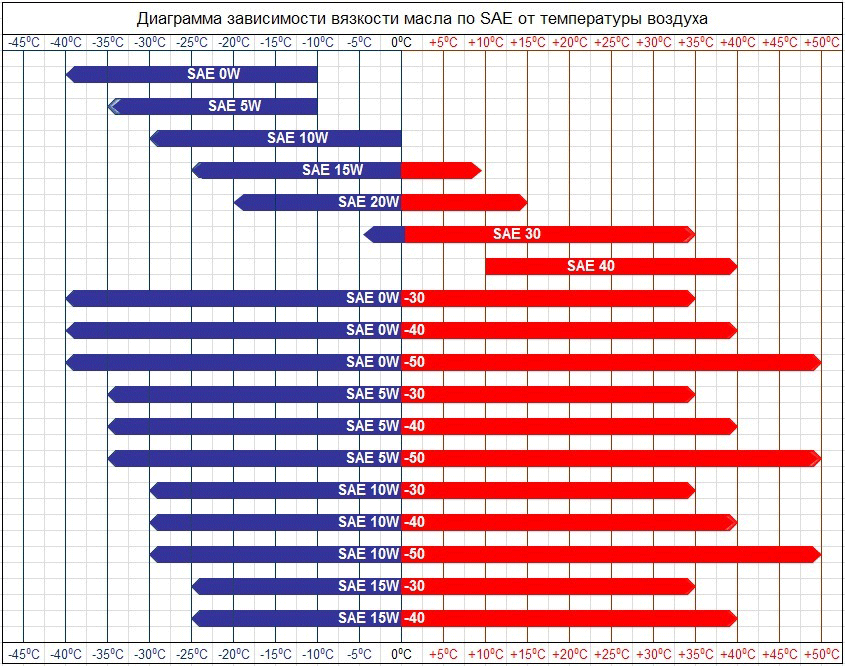
It is important to remember that this specification is quite general. You should not rely solely on the exact selection of oil for the general temperature indicators of the region of residence, it is always better to take with a reserve. Each engine, each brand of car has a unique combination of the degree of forcing, heat stress, design features, materials used, and so on, right down to the quality of surface treatment. Therefore, to achieve maximum performance and efficiency, it is worth relying on all the specifications of engine oil for a specific engine model.